
You are here
Balkan News
Experte zum Börsen-Rücksetzer: «Die einzigen zwei sicheren Häfen sind der Schweizer Franken und das gelbe Edelmetall»
Daniel Hartmann ist Chefökonom des Zürcher Vermögensverwalters Bantleon. Im Interview spricht er über den Börsen-Rücksetzer und die Zinsentwicklung im Sog der Grönland-Krise.
Categories: Balkan News, Swiss News
Grüsel-Ex-Prinz: Wann wird Andrew endlich von der Polizei verhört?
Prinz Harry kommen dieser Tage vor Gericht in London fast die Tränen. Andrew dagegen lacht sich ins Fäustchen. Der Prozess seines Neffens lenkt ab von ihm selbst. Warum wird der gefallenen Sexgrüsel nicht längst in die Mangel genommen? «RoyalTea» kennt den Grund.
Categories: Balkan News, Swiss News
Unsere Community liebt sein Foto – Andreas Herger (27) hat das schönste Polarlicht-Bild geschossen: «Ich wusste genau, welche Einstellungen nötig sind»
Die Nordlichter zu Wochenbeginn lieferten spektakuläre Aufnahmen. Wir haben eure Bilder gesammelt und euch abstimmen lassen. Das Siegerfoto stammt von Andreas Herger (27) – Hobbyfotograf durch und durch. So kam es zum perfekten Shot.
Categories: Balkan News, Swiss News
Vierter Spieler nach Neymar, CR7 und Kane: Lewandowski knackt gegen Prag historische Champions-League-Marke
Mit dem gestrigen 4:2-Erfolg über Slavia Prag sammelt Barça wichtige Punkte im Kampf um die direkte CL-Achtelfinalqualifikation. Torschütze ist dabei auch Lewandowski, der sich dadurch in den Geschichtsbüchern des Wettbewerbs verewigt.
Categories: Balkan News, Swiss News
Polizei eingeschaltet: Hackerangriff auf Energy Gruppe Schweiz
Die Energy Gruppe Schweiz meldet einen Hackerangriff vom 20. Januar 2026: Daten von 85'000 Ticketgewinnern wurden gelöscht und kopiert. Der Vorfall wurde der Polizei und dem Datenschützer gemeldet. Betroffene werden informiert.
Categories: Balkan News, Swiss News
Achtung vor Betrügern an der Haustüre!: Wegen dieser fiesen Masche verlor Else F. (95) ihr Erspartes
In Wohlen AG wird die 95-jährige Else F. Opfer eines dreisten Diebstahls. Betrüger holen 24'000 Franken aus ihrem Tresor. Die Seniorin ist wütend und tieftraurig, wie sie Blick erzählt.
Categories: Balkan News, Swiss News
Wie Trump die globale Entwicklungspolitik umkrempelt
US-Präsident Donald Trump ist ausgesprochen erfolgreich darin, neue Maßstäbe zu setzen. Einen kleinen Vorgeschmack gab der 20. Januar 2025. Die 26 präsidentiellen Dekrete am ersten Tag seiner zweiten Amtszeit sind für sich genommen schon ein Rekord und zeigen: Eines der Hauptprobleme für Beobachter besteht darin, überhaupt einen Überblick zu behalten – darüber, was derzeit geschieht, was relevant sein könnte und was lediglich Nebelkerzen sind.
Categories: Balkan News, Diplomacy & Defense Think Tank News
Wie Trump die globale Entwicklungspolitik umkrempelt
US-Präsident Donald Trump ist ausgesprochen erfolgreich darin, neue Maßstäbe zu setzen. Einen kleinen Vorgeschmack gab der 20. Januar 2025. Die 26 präsidentiellen Dekrete am ersten Tag seiner zweiten Amtszeit sind für sich genommen schon ein Rekord und zeigen: Eines der Hauptprobleme für Beobachter besteht darin, überhaupt einen Überblick zu behalten – darüber, was derzeit geschieht, was relevant sein könnte und was lediglich Nebelkerzen sind.
Categories: Balkan News, Diplomacy & Defense Think Tank News
Wie Trump die globale Entwicklungspolitik umkrempelt
US-Präsident Donald Trump ist ausgesprochen erfolgreich darin, neue Maßstäbe zu setzen. Einen kleinen Vorgeschmack gab der 20. Januar 2025. Die 26 präsidentiellen Dekrete am ersten Tag seiner zweiten Amtszeit sind für sich genommen schon ein Rekord und zeigen: Eines der Hauptprobleme für Beobachter besteht darin, überhaupt einen Überblick zu behalten – darüber, was derzeit geschieht, was relevant sein könnte und was lediglich Nebelkerzen sind.
Categories: Balkan News, Diplomacy & Defense Think Tank News
The Brief – He came, he mocked, he buckled
If we filter out the bluster, Davos delivered a rare Trumpian climbdown. But Europe would be naive to assume that Trump is willing to just move on
Categories: Balkan News, European Union
European Parliament calls for an operational EU mutual defence clause
EU countries are increasingly worried that the United States will not defend Europe
Categories: Balkan News, European Union
Mercosur delay shatters von der Leyen’s grand geopolitical strategy
“Other countries around the globe might think twice before doing agreements with the European Union,” says a senior EPP lawmaker
Categories: Balkan News, European Union
Ryanair CEO uses spat with Musk to sell tickets, talk politics
Michael O'Leary urges Europe to stand up Trump – while slamming online anonymity and EU environment policy
Categories: Balkan News, European Union
L'Armée soigne plus de 2000 personnes à Porga
Dans la commune frontalière de Porga, départemnent de l'Atacora, la présence des Forces de défense et de sécurité (FDS) ne se limite plus aux patrouilles et aux dispositifs de surveillance. Du 14 au 16 janvier 2026 , les FDS ont aussi investi les sites de soins, dans le cadre d'une vaste opération médicale gratuite destinée aux populations locales.
Pilotée par la cellule des actions civilo-militaires de l'opération Mirador, sous la coordination du lieutenant-colonel Tassou Abdou Wassiou, une opération médicale gratuite a mobilisé militaires, policiers et agents de santé départementaux du 14 au 16 janvier 2026 à Porga dans le département de l'Atacora.

Durant trois jours, des milliers d'habitants de Porga et des villages environnants ont afflué vers les sites aménagés pour l'occasion.
Consultations générales, soins courants et distribution gratuite de médicaments ont permis de prendre en charge plus de 2 000 patients, toutes tranches d'âge confondues. Pour les cas jugés plus complexes, une trentaine de personnes ont été orientées vers l'hôpital Saint Jean de Dieu de Tanguiéta afin de bénéficier d'un suivi spécialisé.

Mais au-delà des actes médicaux, l'opération s'est voulue un espace d'échanges. Les Forces de sécurité ont multiplié les discussions avec les populations autour de la prévention, de la vigilance communautaire et du rôle des citoyens dans la lutte contre l'insécurité. Une démarche saluée par de nombreux bénéficiaires, qui y voient un signe d'écoute et de considération.
M. M.
·
Categories: Afrique, Balkan News
21 nominations dans 2 ministères
Vingt et un (21) nominations ont été prononcées au ministère de la Justice et de la Législation, après avis favorable du Conseil supérieur de la Magistrature et au ministère du Numérique et de la Digitalisation. C'est à l'issue du Conseil des ministres de ce mercredi 21 janvier 2026.
I- Mesures individuelles.
Les nominations ci-après ont été prononcées :
· Au ministère de la Justice et de la Législation, après avis favorable du Conseil supérieur de la Magistrature :
A la Chancellerie
Directeur de cabinet
Monsieur Florentin GBODOU
Secrétaire général du ministère
Monsieur Séïdou BONI KPEGOUNOU
Collaborateur à l'Inspection générale des Services judiciaires
Monsieur Henri FADONOUGBO
Dans les juridictions
● Cour d'appel de Parakou
Président
Monsieur Thomas Mahougnon DASSI
Procureur général
Monsieur Koutchoro Ambroise ADJIBOYE
● Cour d'appel d'Abomey
Président
Monsieur Nourou Dine Malick BAKARY
1er Substitut général
Madame Gratias Gwladys GNACADJA HOUESSOU
● A la Cour de Répression des Infractions Economiques et du Terrorisme
Président de la Chambre de jugement des Infractions Economiques et du Terrorisme
Monsieur Antoine YEHOUENOU
Membre de la Commission de l'Instruction
Monsieur Rodrique Serge HOUNMANAKAN
Assesseur à la Chambre de Jugement des Infractions Economiques et du Terrorisme
Monsieur Mawouéna Fidèl TOHOUENOU
● A la Cour Spéciale des Affaires Foncières
Conseillers à la Chambre d'appel
– Monsieur Dossa Guillaume LALLY
– Monsieur Anihouvi Célestin KPONNON
Juge du 3ème cabinet d'Instruction
Monsieur Herbert SOLEVO
● Tribunal de première instance de première classe de Cotonou
Président
Monsieur Sowhannou Gutemberth Adelain Armel AZODOGBEHOU
Juge au tribunal
Monsieur Coffi Paul BIWINTON
Juge du 2ème cabinet d'Instruction
Monsieur Ozias Sèwanou KINTOYESSE
Juge du 3ème cabinet d'Instruction
Monsieur Christophe HOUEDETE
Juge du 4ème cabinet d'Instruction
Monsieur Ebony Viako DASSI
● Tribunal de première instance de première classe de Porto-Novo
Président
Monsieur Kuassi David Marie Joachim ANANI
Procureur de la République
Monsieur Ahouzounvè Alphonse AMOUSSOU
· Au ministère du Numérique et de la Digitalisation
Directrice générale de la Société béninoise des Infrastructures de Radiodiffusion
Madame Patricia Marie-France DOSSOU-GBETE épouse CODJIA.
Categories: Afrique, Balkan News
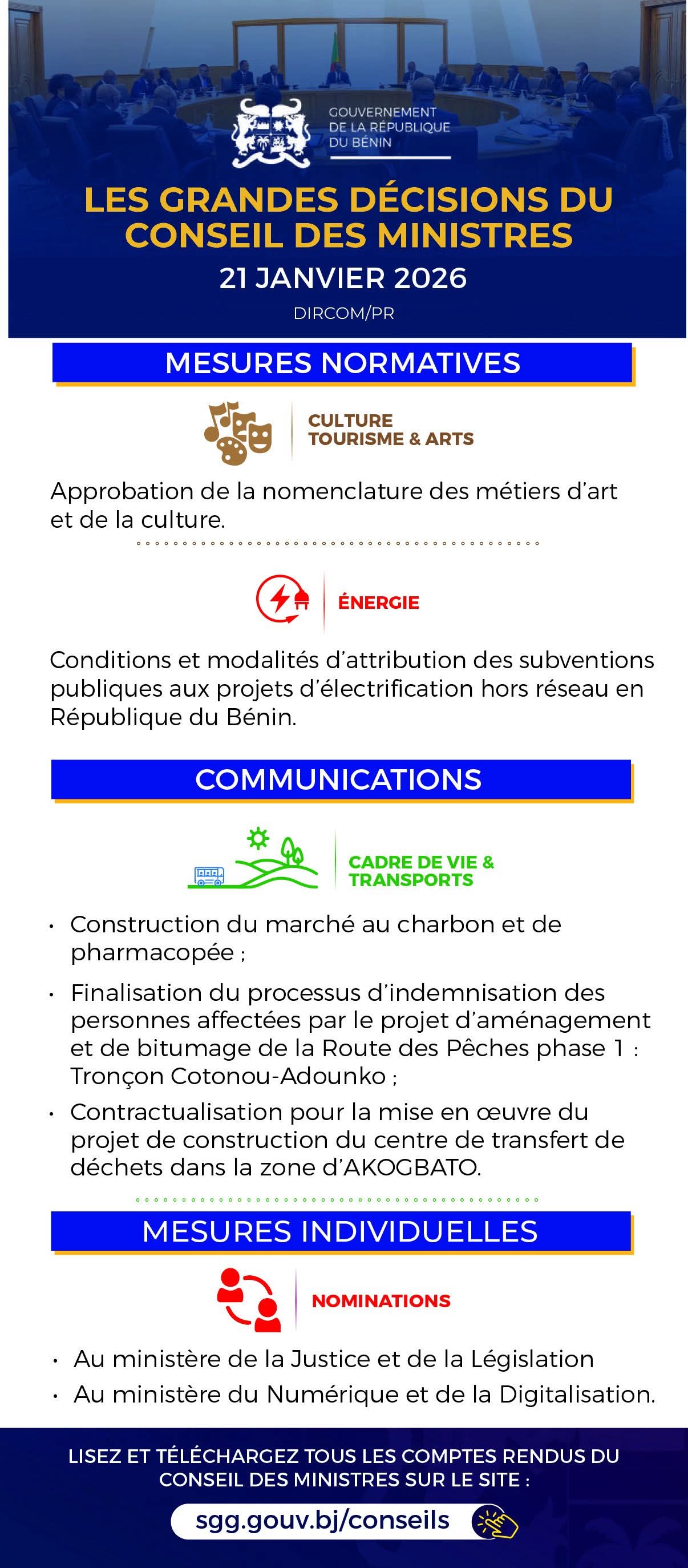
Les grandes décisions du Conseil des ministres
Le Conseil des ministres s'est réuni ce mercredi 21 janvier 2026, sous la présidence du Chef de l'Etat Patrice Talon. Plusieurs grandes décisions ont été prises au cours de cette séance hebdomadaire.
Categories: Afrique, Balkan News
L'ordre des duos fixé sur le bulletin unique de la Présidentielle
Le positionnement des duos de candidats à la présidentielle du 12 avril prochain est désormais connu. C'est à l'issue d'un tirage au sort organisé, mardi 20 janvier 2026 au siège de la Commission Electorale Nationale Autonome (CENA).
Les duos candidats à l'élection présidentielle du 12 avril 2026, représentés par Mariam Chabi Talata et Judicaël Rock Hounwanou, ont participé à la séance de tirage au sort de l'ordre d'apparition des candidats sur le bulletin unique.
À l'issue de l'opération, le duo Romuald Wadagni - Mariam Chabi Talata a hérité de la première position sur le bulletin unique, tandis que le duo Paul Hounkpè - Judicaël Rock Hounwanou occupe la deuxième place.

Au terme de la cérémonie, le président de la CENA a indiqué que les duos retenus seront ultérieurement conviés pour la validation du spécimen du bulletin unique, dernière étape avant l'impression du document électoral.
Mariam Chabi Talata et Judicaël Rock Hounwanou ont quitté les locaux de la CENA sans faire de déclaration à la presse.
M. M.
Categories: Afrique, Balkan News
4 204,7 milliards FCFA mobilisés en 2025, une année de records à la BRVM
La Bourse Régionale des Valeurs Mobilières (BRVM) a présenté, ce mardi 20 janvier 2026 à Abidjan, le bilan de ses activités pour l'année 2025. La rencontre s'est tenue au siège de l'institution, en présence des médias nationaux et internationaux, des acteurs du Marché Financier Régional ainsi que de plusieurs partenaires institutionnels.
Placée sous le thème « De la consolidation des performances à la conquête du futur », la conférence de presse a permis au Directeur Général de la BRVM, Dr Edoh Kossi Amenounve, de revenir sur les résultats enregistrés au cours de l'année écoulée et de dévoiler la vision stratégique de l'institution à l'horizon 2030.
Dans son intervention, le Directeur Général a rappelé que l'année 2025 s'est déroulée dans un contexte international particulièrement tendu, marqué par la fragmentation économique, la persistance des risques géopolitiques et le retour de la guerre économique. À cela s'est ajoutée une croissance mondiale modérée, estimée à 3,2 %.
Malgré ces contraintes, le Marché Financier Régional a démontré sa résilience et son utilité économique. Il a joué pleinement son rôle dans la mobilisation de l'épargne locale et le financement des économies de l'UEMOA, confirmant ainsi son importance stratégique pour la sous-région.
L'un des faits marquants de l'année 2025 reste le niveau exceptionnel de ressources mobilisées sur le marché. Au total, 4 204,7 milliards FCFA ont été levés, un record historique depuis la création du Marché Financier Régional.
Cette performance a été largement soutenue par les émissions obligataires souveraines, traduisant la confiance des États dans le marché régional et l'intérêt soutenu des investisseurs pour les titres publics.
Des indicateurs boursiers en forte progression
Le marché secondaire a également affiché des performances remarquables. L'indice BRVM Composite a progressé de 25,26 %, franchissant un nouveau seuil historique à 345,75 points. Sur une période de cinq ans, la progression cumulée avoisine désormais les 100 %, illustrant la montée en puissance et la maturité croissante du marché.
La capitalisation boursière totale s'est établie à 24 781,3 milliards FCFA, soit 18,37 % du PIB de l'UEMOA. Ces résultats confirment le positionnement de la BRVM comme cinquième bourse africaine et deuxième place africaine pour la cotation des social bonds.
Des avancées structurantes pour renforcer le marché
L'année 2025 a également été marquée par plusieurs réformes et actions structurantes. La BRVM a procédé à la création de nouveaux indices sectoriels afin d'améliorer la lisibilité du marché et de répondre aux besoins des investisseurs.
Elle a également poursuivi le développement de produits innovants, notamment les obligations thématiques, tout en renforçant la promotion de la finance durable. L'introduction en bourse d'une grande banque régionale, considérée comme l'une des plus importantes IPO de l'histoire du marché, a constitué un autre temps fort de l'année. Parallèlement, d'importants efforts ont été consentis pour renforcer la sécurité, la résilience technologique et le plan de continuité des activités.
Au-delà du bilan, la BRVM se projette résolument vers l'avenir. La vision BRVM Horizon 2030 repose sur plusieurs axes stratégiques, parmi lesquels la transformation technologique à travers l'intelligence artificielle, le big data et la blockchain.
Cette vision inclut également le développement de nouveaux produits financiers tels que les ETF et les produits dérivés, le renforcement de la finance durable et inclusive, ainsi que l'approfondissement du marché afin de le rendre plus liquide, plus profond et plus attractif. La promotion de l'éducation boursière dans l'ensemble de l'espace UEMOA figure également parmi les priorités.
En conclusion, le Directeur Général a réaffirmé l'engagement de la BRVM à accompagner les États, les entreprises et les investisseurs dans la transformation économique de la sous-région.
M. M.
Categories: Afrique, Balkan News
Seuls les médias « légaux » peuvent prétendre aux marchés publics
La Haute Autorité de l'Audiovisuel et de la Communication (HAAC), a rappelé à l'ordre les institutions publiques et les annonceurs. Seuls les médias « légaux » peuvent bénéficier de contrats de publicité ou de partenariat.
Dans un communiqué publié lundi 19 janvier 2026, la Haute Autorité de l'Audiovisuel et de la Communication (HAAC) a indiqué que « seuls les médias disposant d'une existence légale au Bénin peuvent régulièrement bénéficier des marchés de publicité, de communication institutionnelle et de partenariat ». Cette mesure cible directement les acteurs de la chaîne des dépenses publiques, des établissements d'etat aux entreprises bénéficiant de fonds publics.
Pour le régulateur, la légalité d'un organe de presse s'apprécie notamment à travers l'obtention d'une autorisation ou d'une déclaration délivrée par la HAAC ; l'inscription effective sur la liste des médias officiellement reconnus et en activité sur le territoire national.
Un appel à la vigilance des comptables publics
La HAAC avertit que tout manquement à ces règles est « contraire aux lois et règlements en vigueur ». De telles pratiques pourraient entraîner des « conséquences juridiques » graves, notamment en ce qui concerne la gestion des deniers publics.
Le Secrétaire général de l'institution, François Awoudo, invite donc les responsables financiers et les ordonnateurs de crédits à faire preuve de la « plus grande vigilance ».
M. M.
Categories: Afrique, Balkan News
Un bâtiment ravagé, d'importants dégâts matériels enregistrés
L'un des bâtiments du Centre hospitalier universitaire départemental (CHUD-Borgou), a pris feu dans l'après-midi de ce mardi 20 janvier 2026. D'importants dégâts matériels ont été enregistrés, mais le bilan humain reste à déterminer.
Incendie au CHUD-Borgou ce mardi 20 janvier. Les flammes selon Fraternité, se sont déclarées dans l'un des bâtiments de l'établissement de santé, et se sont propagées. Les secours, aussitôt alertés se sont dépêchés sur les lieux pour circonscrire le feu et limiter les dégâts.
Une équipe de la Société béninoise d'énergie électrique (SBEE), s'est également rendue sur les lieux pour des vérifications.
F. A. A.
Categories: Afrique, Balkan News
Pages
the old site is here


© 2012-2015 Europa Varietas Foundation © 2015-2020 Europa Varietas Association
www.europavarietas.org | info(@)europavarietas(dot)org | Switzerland
This is a GDPR ready site


We are looking for sponsors for the English translation of these books, please contact turkeandras(at)gmail(dot)com