
You are here
Feed aggregator
Far-right MEP Sarah Knafo launches bid for Paris City Hall
Knafo’s arrival is “bad news” for other right-wing candidates
Categories: European Union, Swiss News
Comment Pékin est passée de partenaire solidaire à puissance sécuritaire.
.
Longtemps présentée comme un partenaire alternatif, porteur d'un discours de solidarité Sud-Sud et de non-ingérence, la Chine est aujourd'hui confrontée à une réalité bien différente en Afrique. À mesure que ses intérêts économiques et humains se sont étendus sur le continent, Pékin a été contrainte d'opérer un tournant sécuritaire majeur, révélateur de son accession au rang de puissance globale.
De l'allié tiers-mondiste à l'acteur dominant
Pendant plusieurs décennies, la présence chinoise en Afrique s'est inscrite dans une narration héritée des luttes anticoloniales. La coopération médicale, l'aide technique et les infrastructures constituaient les piliers d'un engagement présenté comme désintéressé. Cette image, largement relayée par les autorités chinoises, a toutefois été progressivement mise à l'épreuve par l'ampleur croissante des échanges économiques. En 2024, le commerce sino-africain a frôlé les 300 milliards de dollars, faisant de la Chine le premier partenaire économique du continent. Cette intégration massive s'est accompagnée d'un endettement significatif de nombreux États africains à l'égard de Pékin. En Afrique subsaharienne, certaines situations sont devenues particulièrement sensibles, à l'image de Djibouti, où la dette détenue par la Chine avoisine 80 %, ou encore de l'Angola et de la Zambie, dont près d'un tiers de la dette publique est liée à des créanciers chinois.
Une présence humaine devenue un enjeu stratégique
Cette densité financière s'est doublée d'une implantation humaine sans précédent. Le nombre de ressortissants chinois vivant en Afrique est passé de quelque 137 000 au début des années 2000 à plus de deux millions aujourd'hui. Concentrés autour des ports, des sites miniers, des chantiers d'infrastructures et des zones commerciales, ces ressortissants sont devenus des acteurs visibles des économies locales, mais aussi des cibles potentielles dans des contextes d'instabilité. Les violences visant des intérêts chinois en République démocratique du Congo, au Nigeria ou en Centrafrique, ainsi que les enlèvements dans les zones sahéliennes, ont progressivement rapproché la Chine de la condition sécuritaire longtemps réservée aux puissances occidentales. Pékin a dû organiser plusieurs opérations d'évacuation majeures, notamment en Libye, au Soudan du Sud, en Éthiopie et, plus récemment, au Soudan en 2023.
Conclusion
Plus la Chine s'enracine économiquement en Afrique, plus elle est contrainte d'assumer les responsabilités sécuritaires inhérentes à son statut. Ce basculement marque l'entrée définitive de Pékin dans le cercle des puissances exposées, pour lesquelles la protection des intérêts extérieurs n'est plus un choix, mais une nécessité structurelle.
Categories: Afrique, Swiss News
FIRST AID: Why US health shouldn’t copy Denmark
In today's edition: Greek on Ecstasy, Berlin blackout, and Bayer sues Covid jab makers
Categories: European Union, Swiss News
A conversation about AI ethics and innovation with Alexei Grinbaum
This interview examines how AI ethics transitions from high-level principles to real-world systems used by people every day. Alexei Grinbaum, senior scientist and chair of the Operational Digital Ethics Committee at CEA in France, explains why existing ethical guidelines often fail engineers and designers, and how the EU-funded AIOLIA project aims to close that gap. […]
Categories: European Union, Swiss News
AMENDMENTS 1 - 284 - Draft report EU strategy to face the new theories against democracy - PE781.399v01-00
AMENDMENTS 1 - 284 - Draft report EU strategy to face the new theories against democracy
Committee on Foreign Affairs
Bernard Guetta
Source : © European Union, 2025 - EP
Committee on Foreign Affairs
Bernard Guetta
Source : © European Union, 2025 - EP
Comment aider votre corps à se détoxifier
Votre corps possède de nombreux moyens de se purifier. Voici comment l'y aider.
Categories: Afrique
Démarrage des festivités Vodun Days à Ouidah
L'édition 2026 des Vodun Days démarre officiellement ce jeudi 8 janvier, marquant le coup d'envoi de trois jours de célébration de l'art, la culture et la spiritualité Vodun.
Ça y est ! Ouidah entre en effervescence ce jeudi 8 janvier. Dès les premières heures de la matinée, la cité historique vibrera au rythme des danses, rites, et animations culturelles. À partir de 9 heures, les places publiques du cœur de la ville de Ouidah ainsi que la plage accueilleront les premières animations, offrant aux visiteurs une immersion totale dans l'univers vodun. Des animations sont prévues à la Place Maro, sur l'Esplanade du Fort français, à la Place Ninsouxwé, dans la Forêt sacrée de Kpassè, au Temple Mami-Plage et au couvent Sakpata.
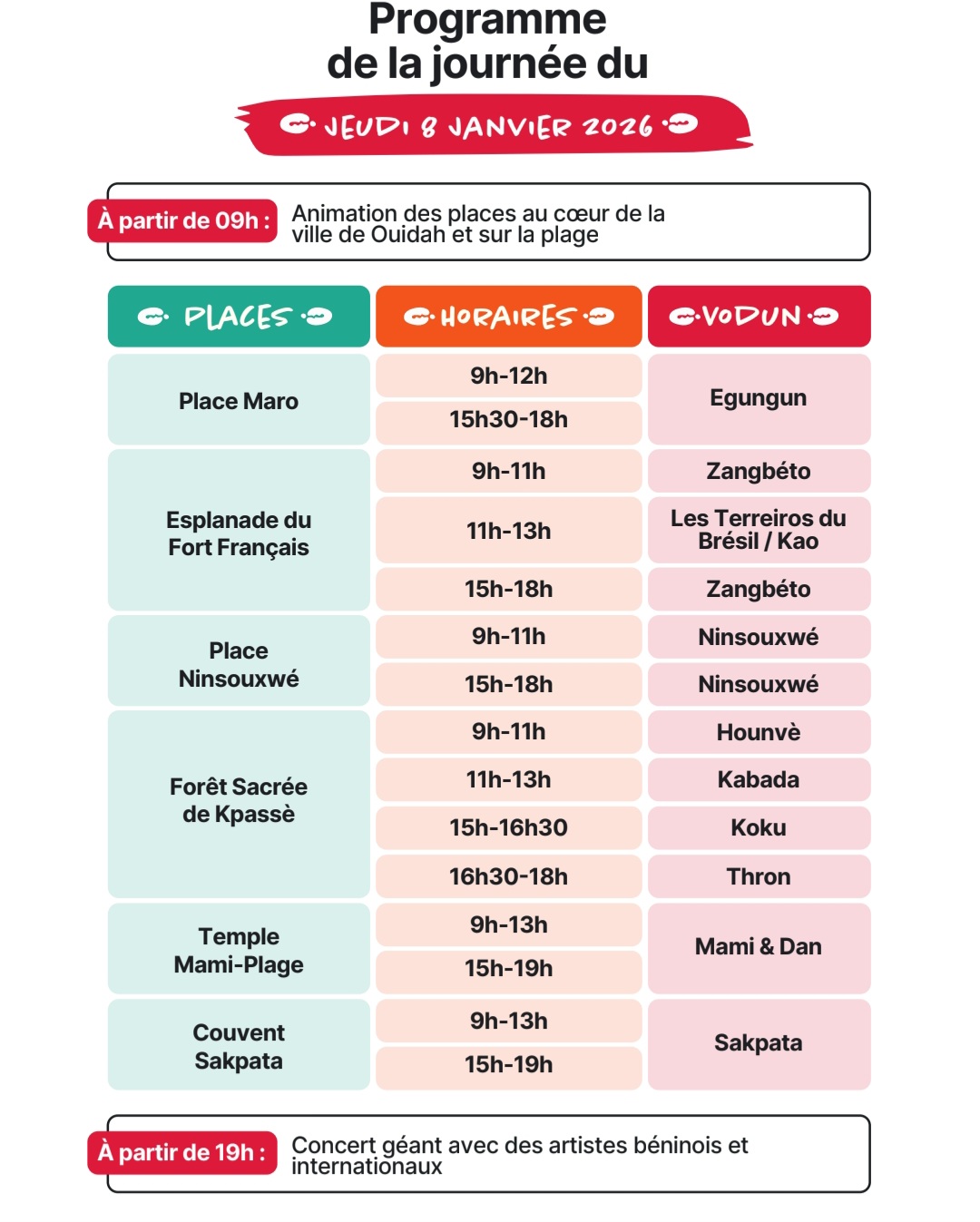
Un concert géant est prévu à partir de 19 heures sur la plage, avec la participation d'artistes béninois et internationaux (X-Time & Ghix, Axel Merryl, Bobo Wê Meiway, légende du Zoblazo, Vano Baby, Angélique Kidjo, Ciara et autres).
A.A.A
Categories: Afrique, Swiss News
Ange Gnacadja révèle son parcours exceptionnel sur RFI
Le célèbre photographe sportif béninois Ange Gnacadja a été l'invité de l'émission Radio Foot International de RFI, mardi 06 janvier 2026, dans le studio de RFI à Rabat, au Maroc.
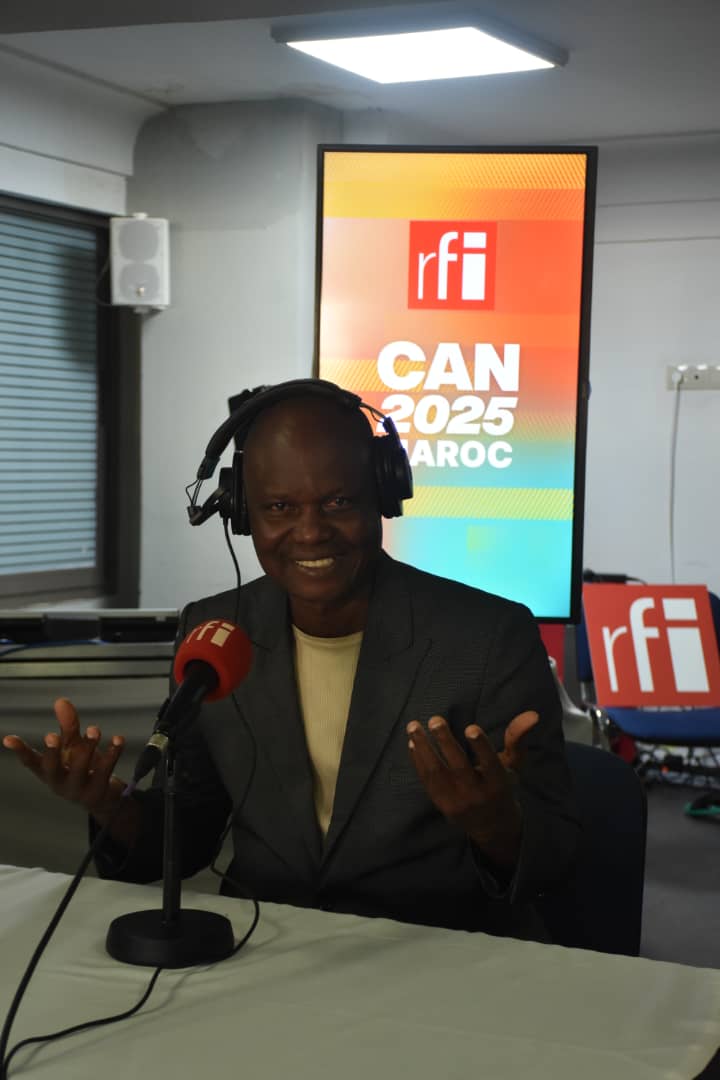
Reçu par la journaliste sportive Annie Gasnier et son équipe, le reporter-photographe béninois est revenu sur un parcours exceptionnel marqué par la couverture de dix Coupes d'Afrique des Nations (CAN).
De Burkina Faso 1998 à la CAN Maroc 2025, en passant par Nigeria–Ghana 2000, Mali 2002, Tunisie 2004, Égypte 2006, Ghana 2008, Angola 2010, Égypte 2019 et Côte d'Ivoire 2023, Ange Gnacadja a partagé son expérience unique des grands rendez-vous du football continental.

Durant près de 30 minutes d'échanges, l'invité de RFI a levé le voile sur les dispositifs tactiques et techniques qu'il met en place pour capturer des images fortes et exclusives lors des grandes compétitions africaines et mondiales.
Au-delà des CAN, le palmarès professionnel de Ange Gnacadja comprend aussi la couverture de trois Coupes du monde seniors, une Coupe du monde junior et des Jeux olympiques, sans compter plusieurs autres compétitions internationales.

Il s'agit du Mondial Seniors Allemagne 2006, Afrique du Sud 2010, Brésil 2014 ; Mondial des cadets Nigeria 2010 ; Mondial Juniors Hollande 2005 et des Jeux Olympiques Londre 2012.
Sans oublier plusieurs Coupes d'Afrique de handball Hommes et Dames avec d'autres compétions des phases préliminaires de la CAF.
Un parcours d'exception qui explique l'intérêt que lui portent les médias internationaux.
A.A.A
Categories: Afrique, Swiss News
Meiway au Bénin pour Vodun Days 2026
L'artiste Meiway est arrivé à Cotonou ce mercredi 8 janvier 2026, dans le cadre des Vodun Days à Ouidah.
L'artiste ivoirien, créateur du mythique Zoblazo est à Cotonou. L'auteur de "Les génie vous parlent" fait partie des vedettes programmées pour le concert de ce jeudi sur la plage de Ouidah. Ce sera une communion, une rencontre entre une légende vivante de la musique africaine et une terre chargée d'histoire, de culture et de spiritualité. Le public est attendu nombreux pour ce moment exceptionnel.
A.A.A
Categories: Afrique, Swiss News
Les Béninois soumis aux cautions de visa USA
``Le Bénin figure désormais sur la liste des pays dont les ressortissants doivent verser une caution lorsqu'ils demandent un visa de visiteur (B-1/B-2) pour les États-Unis.
Des ressortissants de 38 pays dont le Bénin sont appelés à verser une caution avant l'obtention d'un visa de visiteur de type B-1/B-2 (voyage d'affaires ou tourisme) pour l'entrée aux Etats-Unis.
Au Bénin, la décision prend effet à partir du 21 janvier 2026. Les ressortissants du Bénin vont débourser 2,8 millions et 8,4 millions de FCFA pour la caution de visa USA.
« Tout citoyen ou ressortissant voyageant avec un passeport délivré par l'un de ces pays et remplissant les conditions requises pour un visa B1/B2 doit fournir une caution de 5 000 $, 10 000 $ ou 15 000 $ », informe la note du département d'Etat. Le montant est déterminé lors de l'entretien de visa.
« Le dépôt d'une caution ne garantit pas la délivrance d'un visa. Les frais acquittés sans autorisation consulaire ne sont pas remboursables », précise la note. Cette mesure vise à réduire le dépassement des séjours autorisés identifié dans certains pays lors de rapports du Département de la Sécurité intérieure des États-Unis. La caution est remboursable si le voyageur respecte les conditions de son visa (par exemple quitte les États-Unis avant la date limite), ou si le visa lui est refusé ou jamais utilisé.
Categories: Afrique, Swiss News
Brussels upholds global cooperation as US withdraws from top UN climate body
“The decision … is regrettable and unfortunate” the EU's top climate official said
Categories: European Union, Swiss News
Sudan’s War Nears 1,000 Days as Violence and Hunger Reach Unprecedented Levels
Two malnourished children receive food supplements at a health centre in Tawila, North Darfur, Sudan. Credit: UNICEF/Mohammed Jamal
By Oritro Karim
UNITED NATIONS, Jan 8 2026 (IPS)
As Sudan approaches 1,000 days of civil war, late December and early January saw a brutal escalation of violence, with drone strikes hitting areas at the center of the country’s deepening hunger crisis.
While the Rapid Support Forces (RSF) advance across western and southern Sudan, and the Sudanese Armed Forces (SAF) tighten control over the east and the capital, civilians are at a high risk of being caught in the crossfire. Thousands have been displaced as a direct result of violence, humanitarian access remains severely strained, and most civilians are unable to access basic, essential services.
In late December, the International Rescue Committee (IRC) released its annual Emergency Watchlist report, outlining the humanitarian crises in 20 countries and identifying those at the greatest risk of deteriorating conditions in 2026. For the third year in a row, Sudan ranked at the top of the list, with the IRC describing the nation’s crisis as the “largest humanitarian crisis ever recorded”, as well as the largest and fastest growing displacement crisis in the world.
“This crisis is entirely man-made,” said IRC country director for Sudan, Eatizaz Yousif. “The ongoing conflict has decimated livelihoods, displaced millions, and blocked life-saving aid from reaching those in desperate need.” According to IRC estimates, roughly 150,000 Sudanese civilians were killed in 2025—a number expected to rise in the new year as the conflict intensifies and collapsing emergency services struggle to meet rapidly growing needs.
The first week of 2026 have been particularly turbulent for besieged civilians in Sudan. Between January 1 and 3, multiple drone strikes occurred in Dilling, South Kordofan, causing numerous civilian deaths and injuries and generating considerable panic among residents.
On January 3, drone strikes targeted a market and a medical clinic in the Al Zurg and Ghurair villages in North Darfur, which has been described as the “epicenter of Sudan’s hunger crisis” by the United Nations (UN), causing extensive damage. The same day, two drone attacks occurred in the Kulbus locality in West Darfur, leading to the displacement of over 600 civilians.
According to figures from the International Organization for Migration (IOM), between December 31 and January 4, over 1,000 civilians were driven from their homes and fled to South Kordofan as a result of violence. On January 6, brutal clashes between warring parties caused over 2,000 civilians to flee from North Kordofan in a single day.
Conditions for displaced civilians in North Darfur are extremely dire, with the IRC underscoring a widespread lack of access to basic services. Approximately 400,000 families fleeing violence in neighboring El Fasher have arrived in Tawila, overwhelming the region’s already strained humanitarian capacity. Many are living in makeshift shelters without adequate food, clean water, or healthcare. IRC teams have also reported more than 170 young children in Tawila separated from their families, highlighting the severe protection risks facing displaced communities.
“The sight of these small children arriving alone, without the whereabouts or the fate of the rest of their family, is harrowing,” said Arjan Hehenkamp, IRC’s Darfur crisis lead. “Extremely disturbing reports and satellite imagery confirm that people are not able to flee El Fasher to safe places like Tawila, which means they are trapped, detained, or worse.”
On December 29, the United Nations Children’s Fund (UNICEF) conducted a nutritional assessment in North Darfur’s Um Baru locality—one of the regions most affected by conflict and food insecurity—and found that 53 percent of nearly 500 children screened showed signs of acute malnutrition, many of them being under five years old. Eighteen percent of the screened children were found to suffer from severe acute malnutrition, which can be fatal in weeks if left untreated.
“When severe acute malnutrition reaches this level, time becomes the most critical factor,” said UNICEF Executive Director Catherine Russell. “Children in Um Baru are fighting for their lives and need immediate help. Every day without safe and unhindered access increases the risk of children growing weaker and more death and suffering from causes that are entirely preventable.”
According to estimates from the Integrated Food Security Phase Classification (IPC), roughly 21.2 million people across Sudan—nearly half of the population—are experiencing high levels of food insecurity, with over 3.7 million children under five, as well as pregnant and lactating women, urgently requiring treatment for acute malnutrition. Furthermore, famine was officially declared in El Fasher and Kadugli in November, with humanitarian experts projecting that it could spread to 20 additional localities across Darfur and Kordofan.
In late December, the Food and Agriculture Organization (FAO) announced a large-scale seed distribution campaign to assist in winterization efforts and combat Sudan’s deepening nutrition and hunger crisis for the new year. Launched in Khartoum in November, the campaign aims to strengthen and rehabilitate Sudan’s local food production. FAO seeks to reach over 134,000 households, or 670,000 people, across ten states, including Al Jazirah, Blue Nile, Gedaref, Kassala, Khartoum, Northern State, Red Sea, River Nile, Sennar, and the White Nile states.
Targeted households will receive a variety of vegetable seeds including eggplant, green pepper, jute mallow, okra, onion, pumpkin, rocket, snake cucumber, tomato, and zucchini. This campaign aims to restore dietary diversity, improve household nutrition, and revitalize livelihood opportunities. This is crucial for a country like Sudan, in which roughly 80 percent of the population relies on agriculture as a lifeline for food and income.
Additionally, the UN and its partners are working on the ground in Khartoum to strengthen protection services for vulnerable civilians. The United Nations Development Programme (UNDP) is currently in the process of removing debris, distributing medications, creating short-term employment opportunities, and providing psychosocial support.
In late December, UNDP and the UN Secretary General’s Peacebuilding Fund (PBF) launched a campaign titled Strengthening Capacities for Peace and Social Cohesion in Kassala and Red Sea States, in cooperation with UNICEF, to promote gender equality, social cohesion, youth engagement, equitable governance, and successful livelihoods.
“During the war, many of us felt hopeless, but being part of this group gave me purpose,” said Khawla, a youth ambassador from Kadugli trained by the program. “When I see young people listening, asking questions, and starting to believe that peace is possible, I know our work matters. It’s not just about awareness—it’s about restoring trust and rebuilding our communities from the ground up.”
IPS UN Bureau Report
Follow @IPSNewsUNBureau
!function(d,s,id){var js,fjs=d.getElementsByTagName(s)[0],p=/^http:/.test(d.location)?'http':'https';if(!d.getElementById(id)){js=d.createElement(s);js.id=id;js.src=p+'://platform.twitter.com/widgets.js';fjs.parentNode.insertBefore(js,fjs);}}(document, 'script', 'twitter-wjs');
Categories: Africa, Swiss News
THE HACK: Ireland wants to meet X over deepfake porn scandal
In today's edition: Grok DSA enforcement, AI-generated CSAM, and open source for sovereignty
Categories: European Union, Swiss News
HARVEST: Waiting a bit longer?
In today's edition: Mercosur, LSD, fisheries
Categories: European Union, Swiss News
VOLTAGE: Europe’s reliance on US gas overlooked amid Greenland tensions
In today's edition: Gas stockpiling, Greenland, heat from sewage, dangerous dog food
Categories: European Union, Swiss News
Africa Squeezed Between Import Substitution and Dependency Syndrome
President John Dramani Mahama of Ghana addressing the UN General Assembly last September. Credit: UN Photo
By Kester Kenn Klomegah
MOSCOW, Jan 8 2026 (IPS)
Squeezed between import substitution and dependency syndrome, a condition characterized by a set of associated economic symptoms—that is rules and regulations—majority of African countries are shifting from United States and Europe to an incoherent alternative bilateral partnerships with Russia, China and the Global South.
By forging new partnerships, for instance with Russia, these African countries rather create conspicuous economic dependency at the expense of strengthening their own local production, attainable by supporting local farmers under state budget. Import-centric partnership ties and lack of diversification make these African countries committed to import-dependent structures. It invariably compounds domestic production challenges. Needless to say that Africa has huge arable land and human resources to ensure food security.
A classical example that readily comes to mind is Ghana, and other West African countries. With rapidly accelerating economic policy, Ghana’s President John Dramani Mahama ordered the suspension of U.S. chicken and agricultural products, reaffirming swift measures for transforming local agriculture considered as grounds for ensuring sustainable food security and economic growth and, simultaneously, for driving job creation.
President Mahama, in early December 2025, while observing Agricultural Day, urged Ghanaians to take up farming, highlighting the guarantee and state support needed for affordable credit and modern tools to boost food security. According to Mahama, Ghana spends $3bn yearly on basic food imports from abroad.
The government decision highlights the importance of leveraging unto local agriculture technology and innovation. Creating opportunities to unlock the full potential of depending on available resources within the new transformative policy strategy which aims at boosting local productivity. President Mahama’s special initiatives are the 24-Hour Economy and the Big Push Agenda. One of the pillars focuses on Grow 24 – modernising agriculture.
Despite remarkable commendations for new set of economic recovery, Ghana’s demand for agricultural products is still high, and this time making a smooth shift to Russia whose poultry meat and wheat currently became the main driver of exports to African countries. And Ghana, noticeably, accepts large quantity (tonnes) of poultry from Russia’s Rostov region into the country, according to several media reports. The supplies include grains, but also vegetable oils, meat and dairy products, fish and finished food products have significant potential for Africa.
The Agriculture Ministry’s Agroexport Department acknowledges Russia exports chicken to Ghana, with Ghanaian importers sourcing Russian poultry products, especially frozen cuts, to meet significant local demand that far outstrips domestic production, even after Ghana lifted a temporary 2020 avian flu-related ban on Russian poultry.
Moreover, monitoring and basic research indicated Russian producers are actively increasing poultry exports to various African countries, thus boosting trade, although Ghana still struggles to balance imports with local industry needs.
A few details indicate the following:
- * Trade Resumed: Ghana has lifted its ban on Russian poultry imports since April 2021, allowing poultry trade to resume. Russian regions hve, thus far, consistently exported these poultry meat and products into the country under regulatory but flexible import rules on a negotiated bilateral agreement.
* Significant Market: In any case, Ghana is a key African market for Russian poultry, with exports seeing substantial growth in recent years, alongside Angola, Benin, Cote d’Voire, Nigeria and Sierra Leone.
* Demand-Driven: Ghana’s large gap between domestic poultry production and national demand necessitates significant imports, creating opportunities for foreign suppliers like Russia.
* Major Exporters: Russia poultry companies are focused on increasing generally their African exports, with Ghana being a major destination. The basic question: to remain as import dependency or strive at attaining food sufficiency?
* Product Focus: Exports typically include frozen chicken cuts (legs and meat) very vital for supplementing local supply. But as the geopolitical dynamics shift, Ghana and other importing African countries have to review partnerships, particularly with Russia.
Despite the fact that challenges persist, Russia strongly remains as a notable supplier to Ghana, even under the supervision of John Mahama’s administration, dealing as a friendly ally, both have the vision for multipolar trade architecture, ultimately fulfilling a critical role in meeting majority of African countries’ large consumer demand for poultry products, and with Russia’s trade actively expanding and Ghana’s preparedness to spend on such imports from the state budget.
Following two high-profile Russia–Africa summits, cooperation in the area of food security emerged as a key theme. Moscow pledged to boost agricultural exports to the continent—especially grain, poultry, and fertilisers—while African leaders welcomed the prospect of improved food supplies.
Nevertheless, do these African governments think of prioritising agricultural self-sufficiency. At a May 2025 meeting in St. Petersburg, Russia’s Economic Development Minister, Maxim Reshetnikov, underlined the fact that more than 40 Russian companies were keen to export animal products and agricultural goods to the African region.
Russia, eager to expand its economic footprint, sees large-scale agricultural exports as a key revenue generator. Estimates suggest the Russian government could earn over $15 billion annually from these agricultural exports to African continent.
Head of the Agroexport Federal Center, Ilya Ilyushin, speaking at the round table “Russia-Africa: A Strategic Partnership in Agriculture to Ensure Food Security,” which was held as part of the international conference on ensuring the food sovereignty of African countries in Addis Ababa (Ethiopia) on Nov. 21, 2025, said: “We see significant potential in expanding supplies of Russian agricultural products to Africa.”
It mentioned that the Agriculture Ministry’s Agroexport Department, and the Union of Grain Exporters and Producers, exported over 32,000 tonnes of wheat and barley to Egypt totaling nearly $8 million during the first half of 2025, Kenya totaling over $119 million.
Interfax media reports referred to African countries whose markets are of interest for Russian producers and exporters. Despite existing difficulties, supplies of livestock products are also growing, this includes poultry meat, Ilyushin said. Exports of agricultural products from Russia to African countries have more than doubled, and third quarter of 2025 reached almost $7 billion.
The key buyers of Russian grain on the continent are Egypt, Algeria, Kenya, Libya, Tunisia, Nigeria, Morocco, South Africa, Tanzania and Sudan, he said. According to him, Russia needs to expand the geography of supplies, increasing exports to other regions of the continent, increase supplies in West Africa to Benin, Cameroon, Ghana, Liberia and the French-speaking Sahelian States.
Of course, Russian exporters have nothing to complain. Africa’s dependency dilemma still persists. Therefore, Russia to continue expanding food exports to Africa explicitly reflects a calculated economic and geopolitical strategy. In the end of the analysis, the debate plays out prominently and also the primary message: Africa cannot afford to sacrifice food sovereignty for geopolitical solidarity.
With the above analysis, Russian exporters show readiness to explore and shape actionable strategies for harnessing Africa’s consumer market, including that of Ghana, and further to strengthen economic and trade cooperation and support its dynamic vision for sustainable development in the context of multipolar friendship and solidarity.
Kester Kenn Klomegah focuses on current geopolitical changes, foreign relations and economic development-related questions in Africa with external countries. Most of his well-resourced articles are reprinted in several reputable foreign media.
IPS UN Bureau
Follow @IPSNewsUNBureau
!function(d,s,id){var js,fjs=d.getElementsByTagName(s)[0],p=/^http:/.test(d.location)?'http':'https';if(!d.getElementById(id)){js=d.createElement(s);js.id=id;js.src=p+'://platform.twitter.com/widgets.js';fjs.parentNode.insertBefore(js,fjs);}}(document, 'script', 'twitter-wjs');
Categories: Africa, Swiss News
FIREPOWER: Cyprus Presidency kicks off with Ukraine centre stage
Plus Denmark gets poised to fight America, and why Portugal might matter for defence
Categories: European Union, Swiss News
Consent Ignored, Convictions Rare: Pakistan’s Courts Under Fire
Activists at a My body, My choice protest. Credit: Voicepk.net
By Zofeen Ebrahim
KARACHI, Pakistan, Jan 8 2026 (IPS)
As 2026 dawns, women in Pakistan are left grappling with a stark reality: rape and marital rape continue to be misinterpreted by judges in the country’s highest courts.
Earlier this month, Pakistan’s Supreme Court set aside a rape conviction, changing it to fornication (consensual sex out of marriage) – reducing a 20-year sentence to five years and slashing the fine from 500,000 rupees to 10,000 rupees, sparking fresh calls for better protections for Pakistani women.
“Such judgments do not give confidence to women to come out and report sexual violence perpetrated on them,” said Ayesha Farooq, chairperson of the government-notified Committee of the Anti-Rape Investigation and Trial Act, formed in 2021.
Despite protective legislation, 70 percent of gender-based violence incidents go unreported. Of those reported, the national conviction rate stands at just 5 percent, with some categories as low as 0.5 percent and domestic violence convictions at 1.3 percent.
Poor judgments may discourage survivors of sexual violence from reporting their cases to the authorities. Illustration: Kulsum Ebrahim/IPS
Senator Sherry Rehman highlighted the stark figures: in 2024, Islamabad had seven convictions out of 176 rape cases, Khyber Pakhtunkhwa one out of 258, Sindh none from 243 rape cases and Balochistan reported 21 rapes with no convictions.
Nida Aly, Executive Director of AGHS, said, “I have never felt so disappointed in our judiciary. Judges have failed as a gender-competent forum and lost credibility.”
The Supreme Court case involved a survivor who, in 2015, was raped at gunpoint while relieving herself in the woods. She reported the incident seven months later; DNA tests confirmed the accused as the father of her child. The trial court convicted him, and the Lahore High Court upheld the verdict. Yet at the Supreme Court, two of three judges reclassified the act as fornication, citing the complainant’s silence, lack of resistance, and absence of physical marks. Section 496-B of the Penal Code prescribes five years’ imprisonment and a Rs10,000 fine for fornication.
This reasoning drew sharp criticism from the National Commission on the Status of Women, which said consent cannot be inferred from silence, delayed reporting, or lack of resistance, and urged courts to recognise the realities of trauma, fear, coercion, and power imbalances in sexual violence cases.
Ironically, after the recasting of the case, the woman was exempted from punishment.
She was reminded of another case of rape in 2024, where a woman accused her brother’s friend of rape.
“The same judge converted the conviction of rape into fornication – along with arguments like “the woman showed no resistance; there were no marks of violence” and there was a two-day delay in reporting to the police.
Justice Ayesha Malik’s dissenting note arguing there was no “standardised” rulebook response by the victim emphasised consent.
Jamshed M. Kazi, Country Representative, UN Women Pakistan, said such cases resonate far beyond the courtroom. “The language used and the conclusions reached shape not only legal precedent but also social attitudes, survivor confidence, and public trust in justice.”
He added, “For survivors of sexual violence, judgements can leave lasting marks on the lives of women and girls, affecting how their experiences are believed and remembered, and may discourage reporting, reinforcing silence, fear, or self-doubt among survivors.”
Another case saw the Lahore High Court dismiss rape complaints against a husband because he was still legally married, even though he raped the woman at gunpoint. The judge, while maintaining the conduct of the man to be “immoral” and “inappropriate under religious or social norms”, said it was not a crime since the marriage continued to exist legally at the time of the incident.
“The judge focused on the validity of the marriage and completely disregarded the woman’s claim of non-consent and being subjected to forced sex at gunpoint,” pointed out Aly.
While there is no explicit provision criminalising marital rape, the Protection of Women (Criminal Law Amendment) Act, 2006 removed marriage as a defence to rape. When the definition of rape was substantially revised under the Criminal Law (Amendment) Act, 2021, no marital exemption was reintroduced.
Between 1979 and 2006, Maliha Zia, Director, Gender, Inclusion & Development at the Karachi-based Legal Aid Society, explained, marriage operated as a defence to rape because the law defined rape as sexual intercourse by a man with a woman “who is not his wife” under specified circumstances. The deliberate removal of the words “not his wife” in 2006 therefore eliminated marriage as a defence, a position that has remained unchanged since.
“The 2006 Protection of Women Act was an important step; it corrected major injustices by separating rape from zina (unlawful sexual intercourse – including adultery and fornication),” said Dr Sharmila Faruqui, a member of the National Assembly. “But it stopped short of clearly saying that lack of consent within marriage is also rape and that silence has allowed old assumptions to survive.”
Faruqui stressed the need for judicial sensitisation, particularly at senior levels, but noted that judges are ultimately bound by the law. “When the law is unclear, even well-intentioned interpretations can go wrong,” she said. She called for legislative clarity—through a penal code amendment or another carefully considered route—emphasising that consent, grounded in dignity and equality, must remain central regardless of marital status. “Marriage was never meant to be a license for violence.”
This was endorsed by Zia, who has been among the trainers of judges who hear GBV cases. “Much work needs to be done to constantly sensitise the justice sector on women’s experiences and the trauma they go through due to sexual violence. “Many work on the assumption that the woman is most likely lying, especially if she didn’t fight or run or report straight away,” she added.
To its credit, Pakistan, under the anti-rape act of 2021 special courts were notified to look into gender-based violence cases. To date there are 174 such courts. Unfortunately, these courts are not exclusively handling GBV cases, said Zia. But even with this limitation, rape case convictions in Sindh rose to 17 percent in 2025, from 5 percent in 2020, when such courts did not exist. “Imagine how much better it could be!” According to her, in districts where there is a high caseload of GBV, courts should be exclusive, not necessarily more.
IPS UN Bureau Report
Follow @IPSNewsUNBureau
!function(d,s,id){var js,fjs=d.getElementsByTagName(s)[0],p=/^http:/.test(d.location)?'http':'https';if(!d.getElementById(id)){js=d.createElement(s);js.id=id;js.src=p+'://platform.twitter.com/widgets.js';fjs.parentNode.insertBefore(js,fjs);}}(document, 'script', 'twitter-wjs');
Categories: Africa, Swiss News
Arrestation de Nicolás Maduro : quelles répercussions sur la stratégie de la Russie et de la Chine ?
Alors que Nicolás Maduro du Venezuela fait face à des accusations aux États‑Unis, des experts se demandent si sa capture pourrait encourager la Chine et la Russie.
Categories: Afrique, Határon túli magyar portálok összesített hírei
Arrestation de Nicolás Maduro : quelles répercussions sur la stratégie de la Russie et de la Chine ?
Alors que Nicolás Maduro du Venezuela fait face à des accusations aux États‑Unis, des experts se demandent si sa capture pourrait encourager la Chine et la Russie.
Categories: Afrique
Pages
the old site is here


© 2012-2015 Europa Varietas Foundation © 2015-2020 Europa Varietas Association
www.europavarietas.org | info(@)europavarietas(dot)org | Switzerland
This is a GDPR ready site


We are looking for sponsors for the English translation of these books, please contact turkeandras(at)gmail(dot)com